
Fiber Optic Cable
A fiber-optic cable is made of glass or plastic and transmits signals in the form of light.
Properties of light
Ø Light travels in a straight line as long as it moves through a single uniform substance. If traveling through one substance suddenly enters another, ray changes its direction.
Bending of light ray

If
the angle of incidence(the angle the ray makes with the line perpendicular to
the interface between the two medium) is less than the critical angle the ray
refracts and move closer to the surface.
If
the angle of incidence is equal to the critical angle, the light bends along
the interface.
If
the angle of incidence is greater than the critical angle, the ray reflects and
travels again in the denser substance. Critical angle differs from one medium
to another medium.
Optical
fiber use reflection to guide light through a channel.

A Glass or plastic core is surrounded by a
cladding of less dense glass or plastic.
Propagation Modes
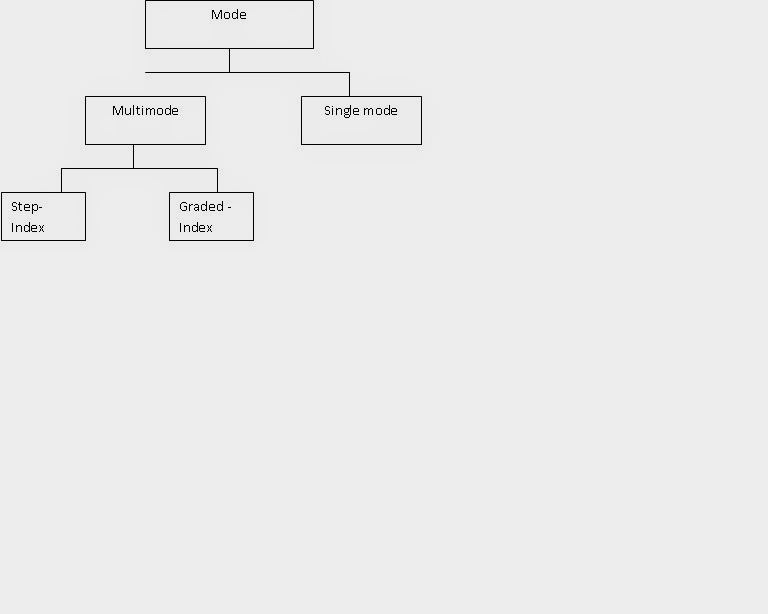
Multimode
In
the multiple mode, multiple light beams from a source move through the core in
different paths.

Ø
Multimode-Step-Index
fiber: The density of core remains constant from
the centre to the edge.
A ray of light moves through this constant
density in a straight line until it reaches the interface of the core and the
cladding. At the interface there is an abrupt change to a lower density that
changes the angle of the beam’s motion.
Ø
Multimode-
Graded -Index fiber: The density is varying. Density is highest
at the centre of the core and decreases gradually to its lowest at the edge.
Single
Mode
Single mode uses step-index fiber and a highly focused source of
light
that
limits beams to a small range of angles, all close to the horizontal.
The single mode fiber itself is manufactured with a much smaller
diameter
than that of multimedia fiber.
Connectors
Ø
Subscriber
channel (SC) connector
is used for cable TV.
Ø
Straight-tip
(ST) connector
is used for connecting cable to networking devices.
