Showing posts with label Computer Networks - Unit 1. Show all posts

Friday, December 19, 2014

Fiber Optic Cable

Fiber Optic Cable
A fiber-optic cable is made of glass or plastic and transmits signals in the form of light.
Properties of light
Ø  Light travels in a straight line as long as it moves through a single uniform substance. If traveling through one substance suddenly enters another, ray changes its direction.
Bending of light ray
If the angle of incidence(the angle the ray makes with the line perpendicular to the interface between the two medium) is less than the critical angle the ray refracts and move closer to the surface.
If the angle of incidence is equal to the critical angle, the light bends along the interface.
If the angle of incidence is greater than the critical angle, the ray reflects and travels again in the denser substance. Critical angle differs from one medium to another medium.
Optical fiber use reflection to guide light through a channel.

A Glass or plastic core is surrounded by a cladding of less dense glass or plastic.

Propagation Modes
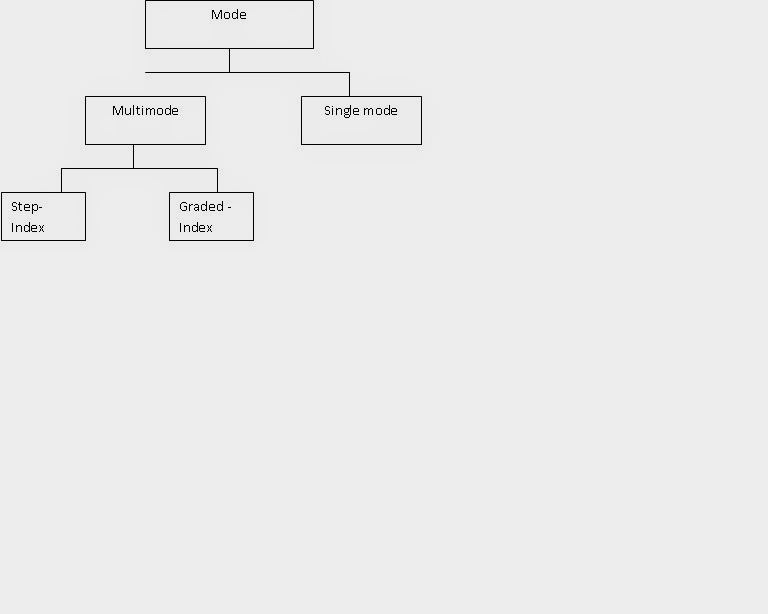
Multimode
In the multiple mode, multiple light beams from a source move through the core in different paths.
Ø  Multimode-Step-Index fiber: The density of core remains constant from the centre to the edge.
A ray of light moves through this constant density in a straight line until it reaches the interface of the core and the cladding. At the interface there is an abrupt change to a lower density that changes the angle of the beam’s motion.
Ø  Multimode- Graded -Index fiber: The density is varying. Density is highest at the centre of the core and decreases gradually to its lowest at the edge.
Single Mode
Single mode uses step-index fiber and a highly focused source of light
that limits beams to a small range of angles, all close to the horizontal.
The single mode fiber itself is manufactured with a much smaller
diameter than that of multimedia fiber.
Connectors
Ø  Subscriber channel (SC) connector  is used for cable TV.
Ø  Straight-tip (ST) connector is used for connecting cable to networking devices.

Friday, December 5, 2014

CS2302 Computer Network

15.  How does NRZ-L differ from NRZ-I?
In the NRZ-L sequence, positive and negative voltages have specific meanings: positive for 0 and negative for 1. in the NRZ-I sequence, the voltages are meaningless.
Instead, the receiver looks for changes from one level to another as its basis for recognition of 1s.

16. What are the responsibilities of data link layer?
Specific responsibilities of data link layer include the following. a) Framing b) Physical addressing c) Flow control d) Error control e) Access control.

17. What are the ways to address the framing problem?
·         Byte-Oriented Protocols(PPP)
·         Bit-Oriented Protocols(HDLC)
·         Clock-Based Framing(SONET)

18. Distinguish between peer-to-peer relationship and a primary-secondary relationship. peer -to- peer relationship?
            All the devices share the link equally.
Primary-secondary relationship: One device controls traffic and the others must transmit through it.

19. Mention the types of errors and define the terms?
            There are 2 types of errors
·         Single-bit error.
·         Burst-bit error.
Single bit error: The term single bit error means that only one bit of a given data unit (such as byte character/data unit or packet) is changed from 1 to 0 or from 0 to 1.
Burst error:  Means that 2 or more bits in the data unit have changed from 1 to 0 from 0 to 1.

20.  List out the available detection methods.
             There are 4 types of redundancy checks are used in data communication.
·         Vertical redundancy checks (VRC).
·         Longitudinal redundancy checks (LRC).
·         Cyclic redundancy checks (CRC).
·         Checksum.

21. Write short notes on VRC.        
The most common and least expensive mechanism for error detection is the vertical redundancy check (VRC) often called a parity check. In this technique a redundant bit called a parity bit, is appended to every data unit so, that the total number of 0’s in the unit (including the parity bit) becomes even.

Monday, November 3, 2014

Computer Networks - Unit 1

21. Write short notes on VRC.        
The most common and least expensive mechanism for error detection is the vertical redundancy check (VRC) often called a parity check. In this technique a redundant bit called a parity bit, is appended to every data unit so, that the total number of 0’s in the unit (including the parity bit) becomes even.

22. Write short notes on LRC.
In longitudinal redundancy check (LRC), a block of bits is divided into rows and a redundant row of bits is added to the whole block.
23. Write short notes on CRC.
The third and most powerful of the redundancy checking techniques is the cyclic redundancy checks (CRC) CRC is based on binary division. Here a sequence of redundant bits, called the CRC remainder is appended to the end of data unit.

24. Write short notes on CRC checker.
A CRC checker functions exactly like a generator. After receiving the data appended with the CRC it does the same modulo-2 division. If the remainder is all 0’s the CRC is dropped and the data accepted. Otherwise, the received stream of bits is discarded and the dates are resent.

25. Define checksum.
The error detection method used by the higher layer protocol is called checksum. Checksum is based on the concept of redundancy.

26. What are the steps followed in checksum generator?
The sender follows these steps a) the units are divided into k sections each of n bits. b) All sections are added together using 2’s complement to get the sum. c) The sum is complemented and become the checksum. d) The checksum is sent with the data.

27. Mention the types of error correcting methods.
There are 2 error-correcting methods.
·         Single bit error correction
·         Burst error correction.

28. Write short notes on error correction?
            It is the mechanism to correct the errors and it can be handled in 2 ways.
·         When an error is discovered, the receiver can have the sender retransmit the entire data unit.
·         A receiver can use an error correcting coder, which automatically corrects certain errors.