
·
System Engineering
·
Software engineering occurs as a consequence of a
process called system engineering.
·
Instead of concentrating solely on software,
system engineering focuses on a variety of elements, analyzing, designing, and
organizing those elements into a system that can be a product, a service, or a
technology for the transformation of information or control.
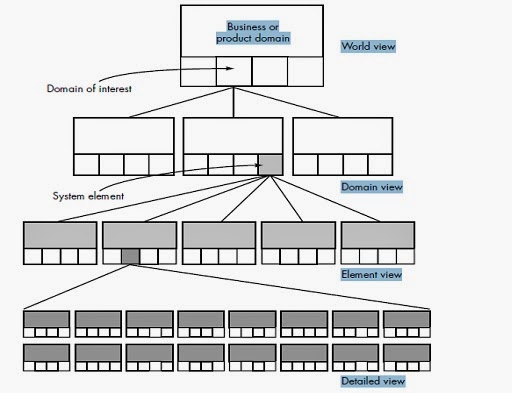
The system engineering process usually begins with a
―world view.‖ That
is, the entire business or product domain is examined to ensure that the proper
business or technology context can be established.
The world view is refined to focus more fully
on specific domain of interest. Within a specific domain, the need for targeted
system elements (e.g., data, software, hardware, people) is analyzed. Finally,
the analysis, design, and construction of a targeted system element is
initiated.
At the top of the hierarchy, a very broad
context is established and, at the bottom, detailed technical activities,
performed by the relevant engineering discipline (e.g., hardware or software
engineering), are conducted.
Stated in a slightly more formal
manner, the world view (WV) is composed of a set of domains (Di), which can each be a system or
system of systems in its own right.
WV = {D1, D2, D3, . . .
, Dn}
Each domain is composed of
specific elements (Ej) each of
which serves some role in accomplishing the objective and goals of the domain
or component:
Di = {E1, E2, E3, . . . , Em}
Finally, each element is
implemented by specifying the technical components (Ck) that achieve the necessary function for an element:
Ej = {C1, C2, C3, . . . , Ck}
